

Blog
How to Adjust Your Gas Stove Air Mixer for a Perfect Blue Flame

How to Adjust Your Gas Stove’s Air Mixer for a Perfect Blue Flame
At Grace Home Appliances, we believe that getting the best performance from your gas stove or hob is not only about choosing a quality appliance—it is also about understanding how your appliance works. One small but important component that can affect burner performance is the air mixer, also known as the primary air shutter.
When the gas and air mixture is properly balanced, your burner can produce a clean, stable blue flame, provide better cooking performance, and help keep your utensils clean. However, after transportation, installation, changes in the gas supply, or changes in the regulator, the flame may sometimes require checking and adjustment.
This guide explains what the air mixer does, why it matters, how to recognize an abnormal flame, and what you should check if your Grace gas stove or hob is not producing the flame you expect.
Which Appliances Have an Air Mixer?
The air-mixer adjustment discussed in this guide applies to gas stoves and gas hobs that use an adjustable primary-air shutter as part of their burner system.
- Gas Stoves: The burner system can use an adjustable air mixer underneath the burner to control primary air entering the gas-air mixing system.
- Gas Hobs: Gas hobs can also use an air-mixer mechanism as part of their burner assembly.
- Gas Geysers: Gas geysers use their own built-in combustion and gas-air management system and are not covered by this air-mixer adjustment guide.
Important: Never attempt to modify the combustion or gas-air system of a gas geyser unless specifically instructed by the manufacturer and carried out by a qualified technician.
What Is an Air Mixer?
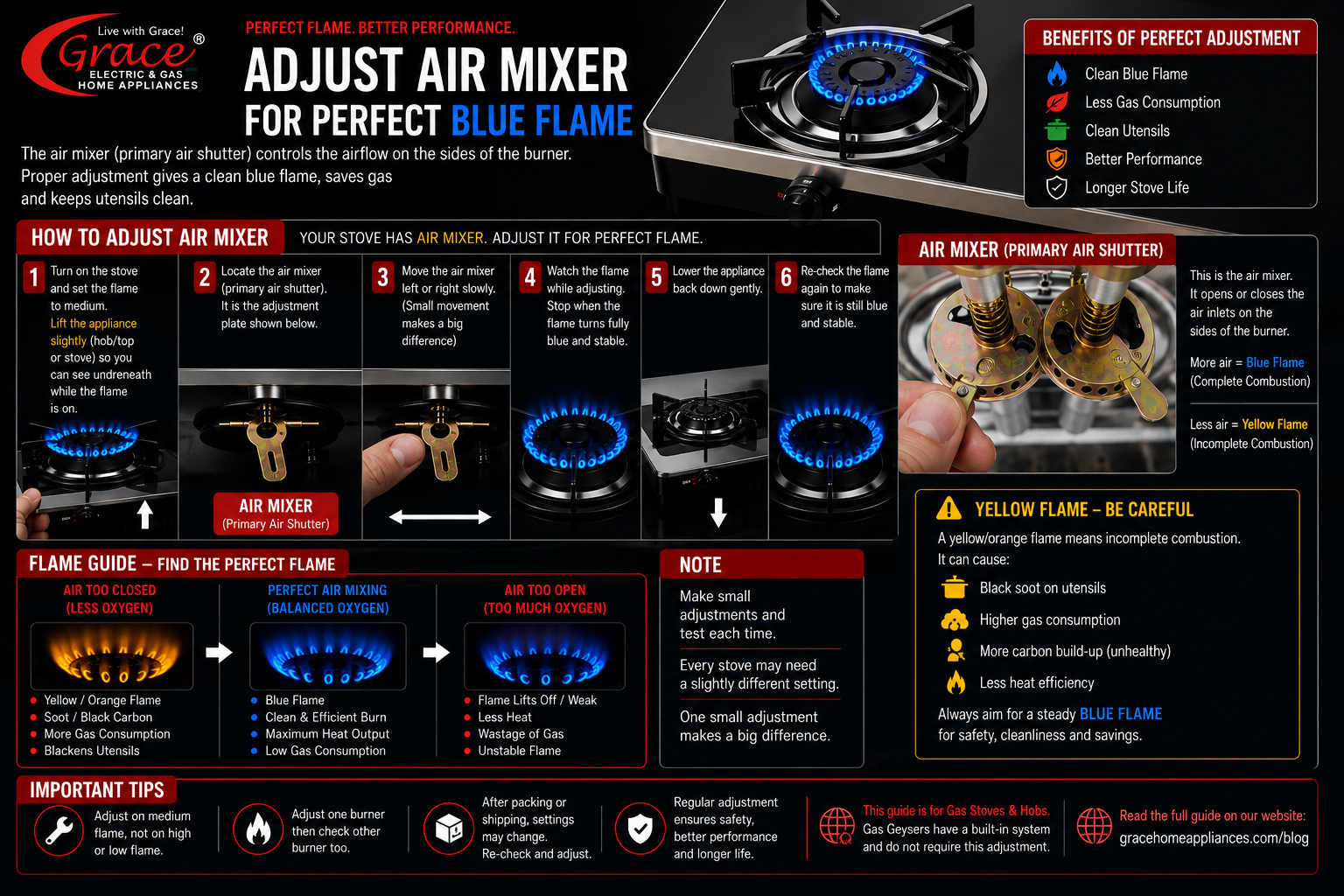
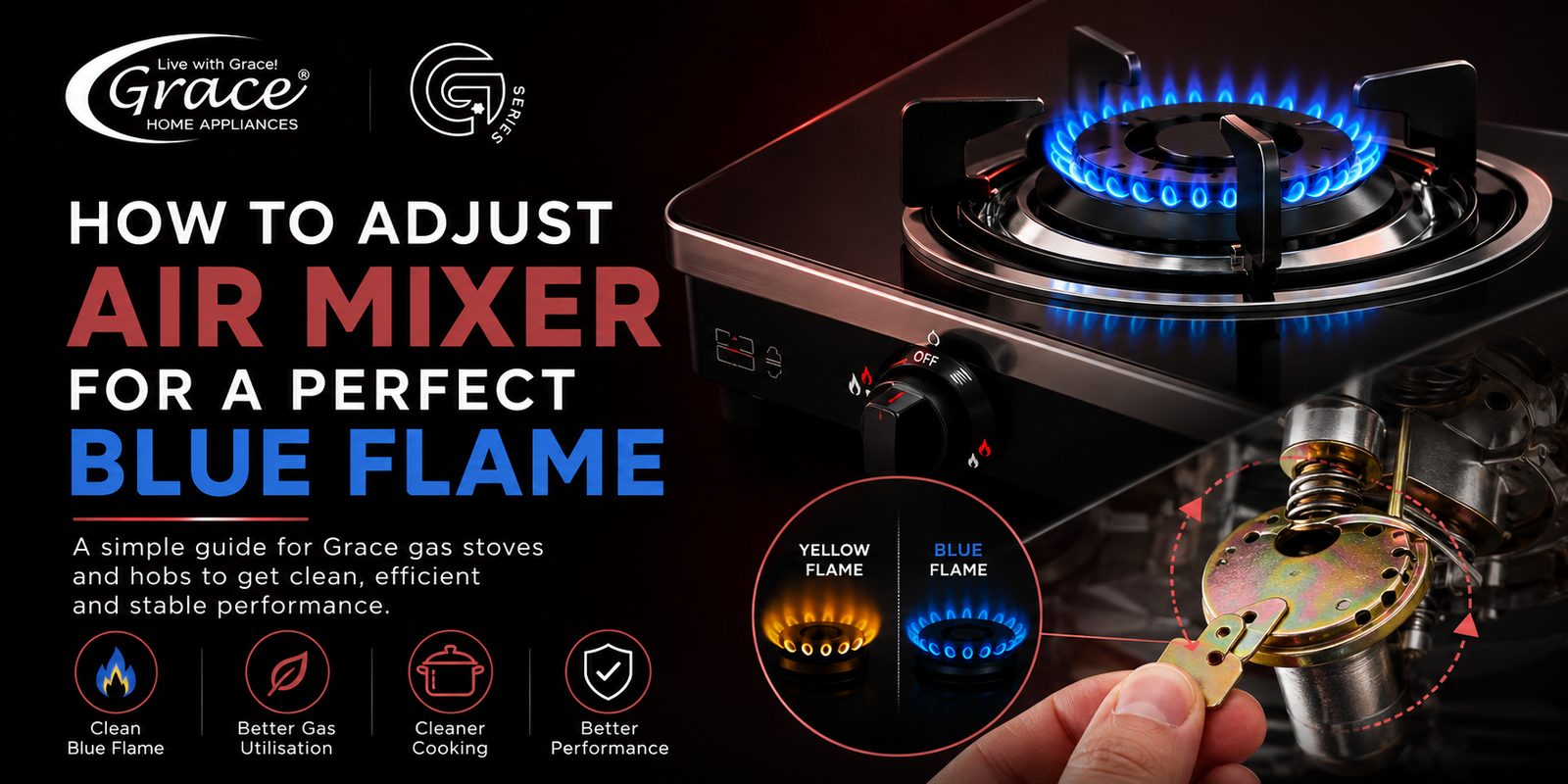
The air mixer is a small adjustable component located underneath the burner. It controls the amount of primary air entering the burner before combustion takes place.
The gas and air need to mix correctly before reaching the burner ports. When the mixture is properly adjusted, the burner can produce a stable and clean flame.
The air mixer is already installed inside your appliance. There is nothing for the customer to insert, install, or replace. The adjustment simply involves checking the existing air-mixer position when required.
🔥 Why Is Air Mixing Important?
Correct air mixing plays an important role in how a gas burner performs. A properly adjusted burner can help provide:
- Clean Blue Flame: A stable blue flame is generally the desired appearance for a properly operating gas burner.
- Better Cooking Performance: Correct combustion helps the burner deliver heat effectively to your cookware.
- Cleaner Utensils: Proper combustion helps reduce soot and black deposits underneath cooking utensils.
- Better Gas Utilisation: Correct combustion helps the burner use the supplied gas effectively.
- Stable Burner Performance: Proper air mixing helps maintain a stable flame during cooking.
🔵 What Does a Perfect Flame Look Like?
For most gas burners, the desired flame is a steady blue flame that is properly seated around the burner ports.
- Steady blue flame
- Even flame around the burner
- Flame remains properly seated on the burner
- No persistent black soot on cookware
- Consistent heating performance
🟡 Why Does a Stove Sometimes Produce a Yellow Flame?
A yellow or orange flame does not always mean that there is a problem with the appliance itself. Several different factors can affect the final flame.
- The air-mixer setting may have shifted.
- The burner ports may be dirty or partially blocked.
- The burner components may not be positioned correctly.
- The gas regulator may not be providing the correct pressure.
- The gas supply may contain contaminants or impurities.
- The gas supply conditions may have changed.
- The appliance may require professional inspection.
This is why it is important not to assume that every yellow flame is caused by the appliance. The complete gas and combustion system should be considered.
🍳 Why Can a Yellow Flame Make Your Utensils Black?
A persistent yellow or orange flame can be a sign of incomplete combustion. Under these conditions, soot and carbon deposits can form and settle underneath cooking utensils.
This is why you may notice that the bottom of your pots and pans becomes black or smoky when a burner is not burning correctly.
A clean, stable blue flame is therefore not only better for the appearance of your burner—it can also help keep your cookware cleaner.
🔧 How to Check and Adjust the Air Mixer
If your gas stove or hob develops an abnormal flame, the air mixer can be one of the components that needs to be checked.
Step 1: Turn On the Burner
Turn the burner on and set it to a medium flame so that you can clearly observe the flame.
If the appliance design and manufacturer's instructions permit safe access to the air mixer while the burner is operating, carefully access the adjustment area so that the flame can be observed while making the adjustment.
Safety first: Never lift, tilt, open, or expose a gas appliance while it is operating unless the specific appliance instructions allow this procedure and safe access can be maintained. If safe access is not possible, the adjustment should be carried out by a qualified technician.
Step 2: Locate the Air Mixer
The air mixer is located underneath the burner. It is the adjustable metal plate or shutter surrounding the burner's primary-air inlet.
It is already fitted into the appliance and does not need to be removed or replaced.
Step 3: Make a Small Adjustment
Make a small and gradual adjustment to the air mixer.
Do not make a large movement at once. Small changes can have a noticeable effect on the flame, so adjust gradually and observe the result after each change.
There is no universal rule that one particular direction always means "more air" or "less air", because the orientation and mechanism can vary between burner designs. The correct position should be determined by the burner and its flame response.
Step 4: Watch the Flame
After each small adjustment, carefully observe the flame.
The objective is a stable, clean blue flame that remains properly seated around the burner.
Step 5: Return the Appliance to Its Normal Position
Once the adjustment is complete, carefully return the appliance to its normal operating position according to the manufacturer's instructions.
Step 6: Re-Check the Flame
Check the burner again in its normal operating position. The flame should remain stable and properly formed.
If the flame remains yellow, unstable, excessively noisy, or lifts away from the burner, do not continue making random adjustments. The burner, regulator, gas supply, or another component may require inspection.
It Isn't Always the Appliance
One of the most important things to understand about gas burner performance is that the appliance is only one part of the complete system.
The final flame depends on several things working together:
Gas Supply → Regulator → Gas Valve/Injector → Air Mixer → Burner → Flame
A problem anywhere along this chain can affect the final flame.
🔧 Regulator Quality Can Affect Performance
The regulator controls the pressure of gas supplied to the appliance. Regulator quality can vary, and an unsuitable, damaged, or poorly performing regulator can affect gas pressure and therefore affect burner performance.
This can sometimes make a properly functioning stove appear to have a burner problem.
If several burners suddenly develop weak, yellow, or abnormal flames, the regulator and gas supply should also be considered rather than repeatedly adjusting each burner.
⛽ Gas Supply Quality Matters Too
The quality and condition of the gas reaching the appliance can also influence burner performance.
Gas containing contaminants or unwanted material can contribute to deposits or blockage in parts of the gas system and burner. This can affect the way gas reaches the burner and ultimately change the flame.
If the problem appears across multiple burners, it is especially important to consider the gas supply and regulator rather than assuming that every burner requires an air-mixer adjustment.
🧽 Keep Your Burner Clean
Air mixing is only one part of maintaining good burner performance.
Food particles, grease, dust, and other deposits can block burner ports and affect the flame. A burner cap or burner head that is not positioned correctly can also result in an uneven or abnormal flame.
- Keep burner ports clean.
- Ensure the burner components are correctly positioned.
- Allow the burner to cool before cleaning.
- Do not block the burner's air openings.
- Do not modify burner ports or injectors.
📦 Why Can the Air-Mixer Setting Change After Delivery?
At Grace Home Appliances, burner performance is checked during our quality-control process before products leave the factory.
However, once an appliance leaves the factory, it can go through several stages:
Factory → Packing → Loading → Transportation → Dealer → Delivery → Installation
During transportation and handling, vibration and movement can sometimes affect small adjustable components. This means a burner that was correctly adjusted during factory quality control may need to be checked again after the appliance reaches its final location.
This does not necessarily mean that there is a manufacturing defect. It is simply one of the reasons why checking the flame after transportation and installation can be useful.
Yellow Flame vs Blue Flame
Understanding the difference between flame conditions can help you identify when your burner may require attention.
- Blue Flame: Generally indicates a cleaner and more complete combustion condition.
- Persistent Yellow/Orange Flame: Can indicate incomplete combustion or another burner, gas-pressure, regulator, or supply issue.
- Black Soot on Utensils: Can be associated with incomplete combustion and should be investigated.
- Flame Lifting or Becoming Unstable: May indicate an air-mixing or gas-supply issue and should not simply be ignored.
⚠️ What If the Flame Is Blue but Unstable?
Blue does not automatically mean that the burner is perfectly adjusted.
If the flame is excessively noisy, lifts away from the burner, repeatedly goes out, or behaves abnormally, the burner may require further inspection.
The goal is not simply to make the flame blue. The goal is a stable, properly seated flame with the correct combustion characteristics for the burner.
❌ What You Should Never Do
Because gas appliances involve combustion and flammable gas, adjustments should always be carried out carefully.
- Do not remove the air mixer.
- Do not replace it with an improvised component.
- Do not permanently block the burner's air openings.
- Do not enlarge burner ports or injector openings.
- Do not make large adjustments at once.
- Do not attempt to adjust a gas geyser's combustion system.
- Do not work on gas connections while the burner is operating.
- Do not continue using the appliance if you smell gas.
🔍 A Simple Flame Troubleshooting Checklist
- Check the burner: Is it correctly positioned?
- Check for blockage: Are the burner ports clean?
- Check the flame: Is it stable and predominantly blue?
- Check the air mixer: Does the adjustment require checking?
- Check the regulator: Is it suitable and functioning correctly?
- Consider the gas supply: Has the cylinder or gas source recently changed?
- Check other burners: Is the problem affecting one burner or several?
- Contact a technician: If the problem remains, have the appliance inspected.
Why This Small Adjustment Matters
The air mixer may be a small component, but it plays an important role in the burner combustion system.
- 🔵 Cleaner blue flame
- 🔥 Better cooking performance
- 🍳 Cleaner utensils
- ⛽ Better gas utilisation
- 💯 More consistent burner performance
A persistent yellow flame, black soot, or an unstable burner should therefore not simply be accepted as normal. It is worth checking the burner, air mixer, regulator, and gas supply to identify the actual cause.
Grace Quality Doesn't End at the Factory
At Grace Home Appliances, we check burner performance during our quality-control process before our products leave the factory.
However, the final cooking environment can vary from home to home. Gas pressure, regulator quality, gas supply, transportation, installation, burner cleanliness, and usage conditions can all influence the final performance of a gas appliance.
That is why understanding your appliance is important. A small amount of attention can help identify problems early and keep your appliance performing the way it should.
🛠️ When Should You Contact a Professional?
Stop making adjustments and contact a qualified gas-appliance technician if:
- You smell gas.
- The flame repeatedly goes out.
- The flame lifts significantly from the burner.
- The flame remains strongly yellow after basic checks.
- Multiple burners suddenly develop abnormal flames.
- The regulator appears damaged or unsuitable.
- A gas connection appears damaged.
- You cannot safely access the air mixer.
- The appliance needs to be opened or dismantled to reach the adjustment.
- You are unsure about the correct adjustment.
Never compromise safety to make an adjustment.
Frequently Asked Questions
Is the air mixer already installed in my Grace stove?
Yes. The air mixer is already installed as part of the burner system. There is no need for the customer to insert or install one. The existing adjustment mechanism can be checked when required.
Do gas hobs also have air mixers?
Yes, compatible gas hobs can use the same type of primary-air adjustment system. The exact mechanism can vary depending on the burner design.
Does a gas geyser need this adjustment?
No. This guide is specifically for gas stoves and gas hobs. Gas geysers use their own built-in combustion and gas-air management system and should not be adjusted using the procedure described in this article.
Why are my utensils turning black?
A persistent yellow or orange flame can be associated with incomplete combustion and soot formation, which may leave black deposits underneath cookware. However, burner blockage, gas pressure, regulator performance, gas quality, and other combustion issues can also contribute.
Can a regulator affect the flame?
Yes. The regulator controls the gas pressure supplied to the appliance. An unsuitable, damaged, or poorly performing regulator can affect burner performance and may sometimes be mistaken for an appliance problem.
Can gas quality affect burner performance?
Yes. The condition and quality of the gas supply can influence burner performance. Contaminants or unwanted material can contribute to deposits or blockage in parts of the gas system and burner.
Should I always adjust the air mixer when I see a yellow flame?
No. First check the burner, burner cap, burner ports, gas supply, and regulator where appropriate. The air mixer is only one possible cause of abnormal combustion.
What is the ideal flame?
Generally, you want a stable, properly seated blue flame appropriate to the burner and gas type. The flame should remain steady and provide consistent heating performance.
Begin Your Grace Experience With Better Flame Performance
Your gas stove or hob is designed to make everyday cooking easier, and understanding a few basic aspects of burner performance can help you get the most from it.
If you notice a persistent yellow flame, black marks underneath your utensils, or an unstable burner, don't immediately assume that the appliance itself is at fault. Check the burner, consider the air mixer, and remember that regulator quality and gas-supply conditions can also affect performance.
With the right burner condition, appropriate gas pressure, clean components, and correct air mixing, your Grace gas stove or hob can continue to deliver the clean, stable flame you expect.
Clean Flame. Better Cooking. Live With Grace!